Urdu Translation Services
Faiz Ahmed Faiz, one of Pakistan's most celebrated poets, wrote in a formal Urdu rooted in Persian and Arabic, entirely distinct from Hindi. That distinction matters commercially. Urdu and Hindi share spoken vocabulary but diverge in script, formal register and cultural association. Content written for one audience does not serve the other.

Brightlines provides Urdu translation services for clients across the UK and internationally. As a UK translation agency, Brightlines works with NHS trusts and healthcare organisations, local authorities and public sector bodies, legal and immigration firms, financial services organisations, charities and NGOs and brands communicating with Urdu-speaking communities in the UK and entering the Pakistani market. Brightlines handles patient and health communications, public sector and community content, legal and certified translation, financial services documentation, brand and marketing copy and high-volume operational materials, matching every project to the correct Urdu register, script conventions and sector expertise.
Urdu at a glance
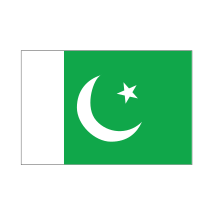
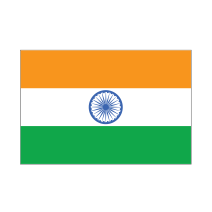
Urdu is the national language of Pakistan and one of India's 22 scheduled languages, with official status in several Indian states including Jammu and Kashmir, Telangana, Bihar, Uttar Pradesh and Delhi. It is spoken by over 230 million people worldwide. In the UK, Urdu is spoken by approximately 400,000 people, primarily within the British Pakistani community concentrated in Bradford, Birmingham, Leeds, Manchester and London, making it one of the most significant community languages for UK public sector and healthcare communication. The facts below cover script, structure, register and the translation risks most relevant to professional content.
- Script: Urdu is written in Nastaliq, a calligraphic variant of the Perso-Arabic script, running right to left. Text direction, character joining, spacing and punctuation all behave differently from Latin-script languages. Script rendering errors visibly compromise the content and undermine the credibility of the communication before it can do its work.
- Vocabulary: Formal written Urdu draws heavily from Persian and Arabic, giving it a distinct literary and official register. Everyday spoken Urdu shares vocabulary with Hindi, but the formal registers diverge sharply. The right vocabulary level depends entirely on the audience, the channel and the content type.
- Hindi and Urdu: Urdu and Hindi are mutually intelligible in spoken everyday use but are entirely distinct in formal written form. Different scripts, different formal vocabularies and different cultural associations mean content prepared for Hindi speakers cannot be applied to Urdu readers. Conflating the two is the most common and most consequential error in this language pair.
- Register and formality: Urdu has a layered formality system. Pronoun and verb form choices signal respect, social distance and relationship, and the social weight of those choices is part of how the text is understood. The choice between formal aap and informal tum or tu changes the relationship between writer and reader. In healthcare, legal and public sector content, the wrong register reads as dismissive or disrespectful.
- RTL layout: Right-to-left text direction affects the entire document structure: text alignment, paragraph flow, numbering, headers and punctuation orientation. These are technical requirements that must be confirmed before layout or typesetting begins, not corrected after delivery.
- Nastaliq rendering: Nastaliq is a connected script in which characters change form depending on their position within a word. Incorrect font or rendering settings produce disconnected characters that are illegible to fluent readers. This is a technical risk that affects digital, print and CMS-rendered content equally.
- Translation risk: The most common Urdu translation failure is register miscalibration, either too formal and distant for a community healthcare leaflet or too informal for a legal or financial document. The second most common is Hindi/Urdu conflation producing vocabulary that Urdu readers do not recognise as their own.
When Urdu translation needs more than accuracy
Script and rendering errors break the text before it can communicate
Urdu's Nastaliq script is right to left and uses connected characters that change form depending on their position within a word. If text direction, character joining or spacing is handled incorrectly in the final document or digital environment, the output is structurally broken in ways a fluent Urdu reader cannot read past. Text that wraps incorrectly, displays as disconnected characters or sits inside a left-aligned layout signals carelessness through the document itself, regardless of what the words say. This is not a minor formatting issue. It is a credibility problem.
Register mismatch reads as disrespect, not just poor translation
Urdu has a layered formality system in which pronoun and verb form choices carry social meaning. A patient information leaflet that uses casual verb forms with an older audience reads as dismissive. A youth-facing campaign that uses highly formal register creates distance where warmth was intended. In healthcare and public sector communications, where trust is the purpose of the content, the wrong register actively undermines the communication. The register must be confirmed before translation begins and checked by a native-level reviewer before delivery.
Hindi and Urdu conflation produces content Urdu readers do not recognise as their own
Urdu and Hindi share spoken vocabulary but diverge sharply in formal written register, script and cultural reference. Content prepared for a Hindi-speaking audience cannot be applied unchanged to Urdu readers. The script is different, the formal vocabulary is different and the cultural associations are different. An Urdu reader encountering Hindi formal vocabulary or Devanagari script meets content that was clearly not produced for them. In community healthcare, public sector and legal communications, that signal damages the relationship the content was produced to build.
Marketing copy loses its persuasive force when translated word for word
Urdu advertising operates on a different cadence from English. Rhythm, phrase length and the relationship between headline and body copy work differently. A direct render of an English tagline often loses the hook, producing something technically clear but motivationally flat. For campaigns and brand content aimed at Urdu-speaking audiences, linguistic accuracy is necessary but not sufficient. The copy must carry the same intent and persuasive weight in Urdu as it does in English, which requires a translator who understands how Urdu-speaking audiences respond to different tones and registers, not just someone who can convert the words.

AI suitability for Urdu translation
AI output for Urdu is improving but remains less reliable than for most European languages, reflecting thinner training data and the additional complexity of Nastaliq script rendering. The limitations emerge in three areas. First, script and character joining: AI output frequently contains rendering errors that produce disconnected or incorrectly formed characters, particularly in Nastaliq. Second, register calibration: AI tends toward a neutral register that sits between formal and informal and is wrong for most professional Urdu content. Third, Hindi/Urdu conflation: AI trained on mixed South Asian data regularly produces vocabulary drawn from Hindi formal register rather than Urdu, which an Urdu-fluent reviewer can identify but a generalist reviewer cannot. Every Urdu project at Brightlines is reviewed by a translator with native-level Urdu reading ability, matched to the content sector and register before delivery.
How clients use our Urdu translation services
Brightlines works with UK and international clients translating content into Urdu for NHS trusts and healthcare organisations, local authorities and public sector bodies with Urdu-speaking resident populations, legal and immigration firms, financial services organisations, charities and NGOs, and brands communicating with UK Pakistani communities or entering the Pakistani market.
- Patient and health communications: patient information leaflets, appointment letters, consent forms, discharge instructions, public health campaigns and clinical trial materials for Urdu-speaking populations in the UK. Specialist Led Translation is required because health content demands both terminological accuracy and a register that is accessible and respectful for the specific community. NHS trusts across Bradford, Birmingham, Leeds and London have statutory communication obligations for Urdu-speaking patients, making this the highest-volume and most distinctively UK-specific Urdu translation demand area.
- Public sector and community content: council communications, housing letters, benefit notifications, consultation documents and community-facing materials for local authorities with significant Urdu-speaking resident populations. Specialist Led Translation is required because public sector content must be accurate, legally sound and pitched at a register that is accessible to a broad community audience including those with lower literacy levels.
- Legal, certified and immigration translation: contracts, certified translations of identity documents, educational qualifications, criminal records, immigration correspondence and legal proceedings materials for Urdu-speaking individuals and organisations in the UK. Specialist Led Translation is required because Urdu legal register is distinct from standard written Urdu in vocabulary and formality, and certified translation for immigration and legal proceedings demands accuracy and approvals-ready formatting.
- Financial services documentation: customer communications, policy documents, regulatory notices and compliance materials for UK financial institutions serving Urdu-speaking communities, and for organisations operating in Pakistani financial markets. Specialist Led Translation is required because financial terminology must be precise and legally defensible, and Urdu financial vocabulary differs between UK community contexts and Pakistani market contexts.
- Brand and marketing copy: consumer and B2B marketing copy, campaign content, social media and brand communications for Urdu-speaking audiences in the UK and Pakistan. Creative Translation is essential here because Urdu consumer culture responds to warmth, a considered tone and register calibration that differs significantly from English promotional conventions. The formal/informal register decision and vocabulary choices must be confirmed before translation begins.
- Education and school communications: parent letters, school newsletters, safeguarding communications and educational materials for Urdu-speaking parents and communities. Specialist Led Translation is required because school and local authority communications carry statutory obligations, and the register must be accessible to parents across a wide range of literacy levels while remaining appropriately formal.
- Operational and internal content at volume: HR documentation, training materials, FAQs and policy updates for organisations with Urdu-speaking workforces or community-facing operations. Smart Translation prioritises clarity and consistency at volume, with human review checking register, vocabulary and Nastaliq rendering conventions before delivery.
What you get with Brightlines
Urdu translators matched to sector
For you: translators matched to the content type, not language pair alone.
Brightlines works with Urdu translators who hold professional experience in the relevant content sector. A translator for NHS and healthcare communications brings knowledge of the community health register and the accessible, respectful tone patient-facing content requires. A translator for legal and immigration content brings familiarity with Urdu legal vocabulary and the formal register certified documentation demands. A translator for brand or consumer marketing brings understanding of how Urdu-speaking audiences respond to different registers and tonal choices. At Brightlines, every Urdu project is matched to a translator with sector experience, not language competence alone.
Human-led review of tone and Hindi/Urdu vocabulary distinction
For you: register fit and Urdu vocabulary accuracy confirmed for UK and Pakistani audiences.
All Urdu translation work at Brightlines goes through a human review stage that checks register appropriateness, the Hindi versus Urdu vocabulary distinction and tonal calibration against the project brief. The Hindi/Urdu check matters because Urdu and Hindi share a spoken base but diverge sharply in formal and literary register: Urdu draws on Persian and Arabic vocabulary where Hindi draws on Sanskrit. A translator working without that distinction in mind can produce text that reads as Hindi written in Nastaliq script rather than as Urdu, which fails the audience even when every word is grammatically correct.
Nastaliq typesetting and RTL format handling
For you: Urdu delivered ready to use, with the Nastaliq script rendering correctly across digital and print.
Nastaliq is more visually demanding than other Perso-Arabic scripts: characters stack diagonally, ligatures form across word boundaries, and standard Arabic or Urdu Naskh fonts do not render Nastaliq correctly. Right-to-left text also affects layout, alignment, line-breaking and the handling of any embedded English. Brightlines provides Urdu typesetting and checks that Nastaliq characters, RTL flow and text-length shifts are all correctly positioned in the final layout. For voiceover and e-learning, scripts are prepared for the spoken register and the regional audience the audio is meant to reach.
Get a quote for Urdu translation services in the UK
Brightlines is a UK translation agency providing Urdu translation services to NHS trusts and healthcare organisations, local authorities and public sector bodies, legal and immigration firms, financial services organisations, charities and NGOs and brands communicating with Urdu-speaking communities in the UK and entering the Pakistani market. We work with patient and health communications, public sector and community content, legal and certified translation, financial services documentation, brand and marketing copy, education and school communications and high-volume operational materials, matching every project to the correct Urdu register, script conventions and tier. If you need Urdu translation that reaches Urdu-speaking audiences with accuracy and the right register, talk to us about your project.


Sound local in every language.
If your content has to sell, persuade, reassure, or build trust, the choices between the words matter. We keep a human in control on every project, then use supportive tools only where they genuinely help. The result is writing that reads cleanly, stays consistent, and sounds like you, not a template.

Industry Experience

International Reach

Speed & Accuracy
Supported
Languages
We support a wide range of languages, from major global markets to specialist regional languages.