Greek Translation Services
Nikos Kazantzakis, one of Greece's most celebrated novelists, wrote in a Greek shaped by three thousand years of literary tradition. That weight persists: four cases, three genders, a register rooted in antiquity. Greek is the official language of Greece and Cyprus. The varieties differ commercially. Specifying the wrong one is not a minor error.

Brightlines provides Greek translation services for clients across the UK and internationally. As a UK translation agency, Brightlines works with shipping and maritime businesses, travel and hospitality companies, brands and consumer businesses, legal and immigration firms, NHS trusts and healthcare bodies, pharmaceutical and life sciences organisations, technology companies, and individuals and organisations requiring certified translation. Brightlines handles shipping and maritime documentation, travel and hospitality content, brand and marketing copy, legal and certified translation, medical and pharmaceutical content, website localisation and high-volume operational materials, matching every project to the correct Greek variety, register and sector expertise.
Greek at a glance
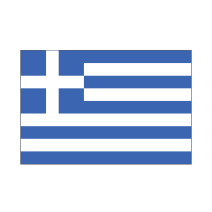
Modern Greek (Ελληνικά) is the official language of Greece and Cyprus, spoken by approximately 13 million native speakers, with significant diaspora communities in Australia, the United States, the UK, Germany and Canada. Greece has one of the world's largest merchant shipping fleets, making maritime and shipping translation a distinctively Greek professional demand area. The facts below cover script, grammar, register, the Greece/Cyprus distinction and the translation risks most relevant to professional content.
- Script: The Greek alphabet (αλφάβητο), consisting of 24 letters, is one of the oldest writing systems still in continuous use. It is written from left to right and uses both uppercase and lowercase letters, similar to Latin script, though certain letters and accent rules behave differently. Modern Greek uses a monotonic accent system with a single stress mark (τόνος) placed over the stressed vowel in words of more than one syllable. Transliteration of names and brand terms between Greek and Latin scripts requires careful handling, as conventions vary between formal and informal contexts.
- Speakers: Approximately 13 million native speakers, primarily in Greece (around 10.7 million) and Cyprus (around 1.2 million).
- Grammar: Modern Greek is a highly inflected language with four grammatical cases (nominative, genitive, accusative, vocative), three genders (masculine, feminine, neuter) and a complex verb system that marks tense, aspect, mood and voice. Noun, adjective and article agreement across gender, number and case is a structural requirement, and errors in agreement are apparent across the entire sentence, because inflection connects every element.
- Register and diglossia: Greek has a historical distinction between Katharevousa (a formal, archaising register used in official and legal documents until 1976) and Demotic (the vernacular standard). Modern Standard Greek is based on Demotic, but Katharevousa vocabulary and constructions persist in legal, religious and some institutional contexts. Translators working on Greek legal content must understand this legacy. Formal Greek also uses the polite plural (εσείς instead of εσύ) in professional and customer-facing communication.
- Greece vs Cyprus: Greek as spoken and written in Cyprus carries distinct vocabulary, expressions and some grammatical differences from Standard Greek as used in Greece. Cypriot Greek incorporates Turkish and English loanwords not found in mainland Greek. Content aimed at Cyprus should be reviewed by a Cypriot Greek speaker, and the target market must be confirmed at brief stage.
- Punctuation: Greek punctuation differs from English in ways that affect translation. The Greek question mark is a semicolon (;), and the Greek semicolon is a raised dot (·). These differences must be handled correctly in typeset documents and UI strings.
- Translation risk: The most common Greek translation failure is producing text with incorrect gender-case agreement or at the wrong register. Greek is a language where grammatical errors are structural, not incidental, because inflection carries meaning across every element of the sentence. Content that reads as grammatically approximate rather than precise loses credibility with Greek audiences.
When Greek translation needs more than accuracy
Inflectional errors ripple through the entire sentence
Greek’s case and gender system means that nouns, adjectives, articles and pronouns must all agree across gender, number and case within every sentence. An error in one element creates a mismatch that runs through the entire sentence. This is not comparable to a minor grammatical slip in English. In Greek, a gender disagreement between a noun and its adjective changes the structural logic of the sentence. Translation that produces correct vocabulary but incorrect agreement reads as fundamentally flawed to a Greek audience.
Katharevousa vocabulary persists in legal and institutional Greek
Although Katharevousa was officially replaced by Demotic Greek as the standard in 1976, its vocabulary and constructions remain embedded in legal documents, official correspondence and some institutional contexts. A translator working on Greek legal content must recognise and apply Katharevousa-derived terminology correctly. Conversely, using Katharevousa forms in consumer or marketing content sounds archaic and out of touch. The translator must know which register is appropriate for the content type.
The formal/informal distinction carries social weight in professional contexts
Greek distinguishes between formal address (εσείς, the polite plural) and informal address (εσύ, the singular). In business, customer-facing and institutional communication, the polite plural is standard. Using the informal singular in professional content signals overfamiliarity. In marketing aimed at younger audiences, informal address may be appropriate. The choice must be agreed in advance and applied consistently throughout the content.
Greek punctuation is not interchangeable with English
The Greek question mark looks like an English semicolon. The Greek semicolon looks like a raised dot. Commas and full stops are the same. These differences are small but visible, and incorrect punctuation in Greek text signals that the content was not produced by someone familiar with the language. In UI localisation, customer communications and typeset documents, punctuation handling must be verified.
πάρεξ ελευθερία και γλώσσα;»

AI suitability for Greek translation
Greek’s rich morphology, with nouns, adjectives and articles all inflecting for gender, number and case, creates consistent opportunities for AI to produce text that is close but structurally wrong. Gender-case agreement errors are common in AI-generated Greek, and they compound across a sentence in ways that degrade credibility even when individual words are correct.
Register calibration is also unreliable: AI does not consistently distinguish between formal and informal address, and it does not handle the Katharevousa vocabulary that persists in legal and institutional contexts. Punctuation handling is inconsistent, with AI sometimes applying English conventions to Greek text. No Greek project leaves Brightlines without human review by a translator who can verify gender-case agreement throughout, confirm the correct Greek or Cypriot variety and check that register meets the standard Greek professional audiences expect.
How clients use our Greek translation services
Brightlines works with UK and international clients translating content into Greek for shipping and maritime businesses, travel and hospitality companies, brands entering the Greek and Cypriot markets, legal and immigration firms, healthcare and pharmaceutical organisations, and individuals and organisations requiring certified translation across Greece and Cyprus.
- Travel, hospitality and tourism content: hotel communications, destination marketing, guest-facing materials and travel content for the Greek market. Creative Translation is essential here because Greece's tourism sector demands content that reflects Greek warmth and hospitality conventions, and register quality matters in a market where visitors and partners expect polished written Greek.
- Brand and marketing copy: consumer and B2B marketing copy for the Greek and Cypriot markets. Creative Translation is essential here because Greek marketing copy must operate at the correct register for the audience, with the formal/informal distinction and any Greece/Cyprus vocabulary differences confirmed before translation begins.
- Legal and compliance documents: contracts, regulatory filings and certified translations for Greek and Cypriot organisations or EU-regulated contexts. Specialist Led Translation is required because Greek legal language retains Katharevousa-derived vocabulary and formal register conventions that differ from standard written Greek. Greece and Cyprus also operate under different legal frameworks despite sharing the language.
- Shipping and maritime documentation: charter parties, bills of lading, ship management contracts, crew documentation, port communications and regulatory filings for Greek shipping companies with UK operations and UK maritime businesses with Greek partners. Specialist Led Translation is required because Greek maritime terminology carries precise legal and operational meaning. A significant concentration of Greek shipowners and shipping firms operates through London, and they expect documentation to meet the formal register conventions of the sector.
- Website and e-commerce localisation: marketing pages, product content, UI strings and digital interfaces for Greek-speaking audiences. Creative Translation for brand and conversion-focused pages, with Smart Translation for support and informational content. Greek punctuation, script rendering and text direction must be verified across all platforms.
- Medical and pharmaceutical content: patient information, clinical documentation and regulatory submissions for the Greek market. Specialist Led Translation is required because Greek medical terminology draws on classical Greek roots but applies them in ways specific to modern medical practice, and register must be appropriate for patient-facing versus clinical content.
- Operational and internal content at volume: HR policies, training materials, onboarding documentation and internal communications for organisations with Greek-speaking workforces. Smart Translation prioritises clarity and consistency at volume, with human review checking grammatical agreement across gender, number and case, register and Greek punctuation conventions before delivery.
- Certified and immigration translation: certified translations of identity documents, birth and marriage certificates, educational qualifications, legal correspondence and immigration documentation for Greek-speaking individuals in the UK and for UK organisations with Greek-speaking staff. Specialist Led Translation is required because certified translation for UK legal and immigration purposes must meet specific accuracy and format standards, and Greek document conventions differ from UK equivalents in ways that affect how they must be presented.
What you get with Brightlines
Greek translators matched to Greece or Cyprus
For you: translators matched to the target market (Greece or Cyprus) and content type, with the grammatical and register precision Greek demands.
Brightlines works with Greek translators who are native speakers and hold professional experience in the relevant content sector. A legal translator brings knowledge of Katharevousa-derived legal vocabulary and Greek regulatory conventions. A brand translator brings understanding of how Greek consumers respond to different registers and tonal choices. At Brightlines, every Greek project is matched to a translator who knows whether the content is for Greece or Cyprus, understands the register the content type requires, and has sector experience in the relevant field.
Human-led quality with gender-case agreement and register checked
For you: gender-case agreement, register and Greek punctuation confirmed before delivery.
Every Greek translation project at Brightlines is quality-assured by a human specialist before delivery. This includes checks for grammatical agreement across gender, number and case, register and formal/informal consistency, Greece/Cyprus variety distinctions, Katharevousa vocabulary in legal contexts and Greek punctuation conventions across all deliverables.
Greek grammatical standards and cultural fit
For you: Greek copy that reads as crafted for a Greek audience, not converted from English.
Brightlines translates brand, legal and marketing content into Greek with knowledge of how Greek audiences judge written content. In Greek, agreement must hold across every inflected element, and register must match the context: both are baseline requirements, not refinements. Content produced for a UK brand entering the Greek or Cypriot market is reviewed for grammatical precision, correct register, cultural fit and natural Greek expression, not just linguistic accuracy.
Get a quote for Greek translation services in the UK
Brightlines is a UK translation agency providing Greek translation services to shipping and maritime businesses, travel and hospitality companies, brands and consumer businesses, legal and immigration firms, NHS trusts and healthcare bodies, pharmaceutical and life sciences organisations, technology companies, and individuals requiring certified translation. We work with shipping and maritime documentation, travel and hospitality content, brand and marketing copy, legal and certified translation, medical and pharmaceutical content, website localisation and high-volume operational materials, matching every project to the correct Greek variety, register and sector expertise. If you need Greek translation that meets the precision and quality Greek audiences expect across Greece and Cyprus, talk to us about your project.


Sound local in every language.
If your content has to sell, persuade, reassure, or build trust, the choices between the words matter. We keep a human in control on every project, then use supportive tools only where they genuinely help. The result is writing that reads cleanly, stays consistent, and sounds like you, not a template.

Industry Experience

International Reach

Speed & Accuracy
Supported
Languages
We support a wide range of languages, from major global markets to specialist regional languages.