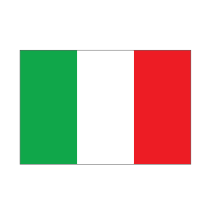
Italian Translation Services
Giacomo Leopardi, one of Italy's most celebrated nineteenth-century poets, found profundity not in grandeur but in restraint. That instinct runs through Italian written culture. The gap between a Milanese brief and a Neapolitan welcome, the weight of formal address, the precision register demands: these are professional expectations, not style choices.

Brightlines provides Italian translation services for clients across the UK and internationally. As a UK translation agency, Brightlines works with clients translating into Italian across a wide range of content types and registers: brand and marketing copy for Italian consumer audiences, legal and compliance documentation for Italian organisations, literary and publishing translation, travel and hospitality content for Italian-speaking markets, and operational content for businesses with Italian-speaking workforces. Italian translation at Brightlines is matched to the register, formality level and sector the brief requires.
Italian at a glance
Italian is spoken by approximately 65 million native speakers in Italy, Switzerland, San Marino, Vatican City and diaspora communities worldwide. The facts below cover script, speaker geography, standard Italian and register conventions.
- Script: Latin alphabet, 21 core letters. Italian does not use k, j, w, x or y except in loanwords. Accented vowels (à, è, é, ì, ò, ù) carry meaning and must be reproduced correctly.
- Speakers: Approximately 65 million native speakers in Italy, plus speakers in Switzerland (where Italian is one of four official languages), San Marino, Vatican City and significant diaspora communities worldwide.
- Standard Italian: Modern standard Italian (italiano standard) is based on the Tuscan dialect, codified through Dante, Petrarch and Boccaccio and standardised through education and media. Regional dialects (Sicilian, Venetian, Neapolitan and others) remain widely spoken but are distinct from standard written Italian.
- Address forms: Italian uses formal Lei and informal tu. The Lei/tu distinction is one of the most register-sensitive choices in Italian translation. In formal and professional contexts, Lei is expected. In consumer marketing, the choice between Lei and tu signals brand positioning and relationship intent.
- Bella figura: Italian professional and commercial culture places high value on bella figura, the presentation of self and organisation through quality of expression. Poorly written Italian, or Italian that is technically correct but stylistically flat, reflects on the organisation producing it. This is a buyer risk, not an aesthetic preference.
- Regional commercial variation: North Italian business communication (particularly in Milan and Turin) tends toward concision and formality. Southern Italian and Roman registers can carry more warmth and relational tone. This distinction matters in sales, hospitality and customer-facing content.
- Translation risk: Italian readers are sensitive to register and stylistic quality. Copy that is linguistically correct but pitched at the wrong register, too casual in a formal context or too stiff in a consumer context, undermines the credibility of the organisation producing it.
When Italian translation needs more than accuracy
Bella figura means stylistic quality is a professional requirement, not a bonus
Bella figura, the cultural emphasis on presenting well, applies to written Italian as much as personal presentation. In Italian business and professional culture, quality of written expression reflects on the organisation. A legal letter written in flat, utilitarian Italian reads as unprofessional. A brand campaign written in correct but tonally flat Italian signals a brand that has not invested in its Italian market. The standard is not just correctness. It is quality of expression.
The Lei/tu distinction signals relationship intent, and getting it wrong breaks trust
Lei (formal you) and tu (informal you) in Italian are not interchangeable register levels. Lei signals professional distance and respect. Tu signals familiarity or a deliberate brand choice to be conversational. Using tu in a formal legal or business document reads as disrespectful or amateurish. Using Lei in a consumer campaign can read as cold or stilted, depending on sector and brand positioning. The choice must be made deliberately and applied consistently throughout a document or campaign.
Northern and southern Italian commercial registers have different expectations
Milan-based business culture values precision, brevity and formal register in professional communications. Italian from Rome and the south tends to carry more relational warmth, longer sentences and different conventions for courtesy expressions. Neither is more correct than the other. Both are normal in their contexts. Translation that ignores regional register norms produces Italian that reads as misjudged to the audience it is meant for.

AI suitability for Italian translation
Grammatical accuracy in standard Italian does not mean a text works for an Italian reader, and that gap is where AI translation falls short. Register is the first problem: AI does not reliably calibrate Lei/tu, produces stylistically flat prose that fails bella figura expectations in formal and brand contexts and cannot distinguish between northern and southern Italian commercial conventions. The result is copy that is technically correct but tonally wrong.
For brand copy, legal text and any content where quality of expression reflects on the organisation, human review does the decisive work. An Italian text that is correctly structured but pitched at the wrong register is harder to catch than an obviously poor one, which is why every Italian project at Brightlines is reviewed by a translator before delivery.
How clients use our Italian translation services
Brightlines works with UK and international clients translating content into Italian across publishing, brand, legal, NGO and operational sectors. Projects span publishers translating books into Italian for Italian-language markets, brands entering Italy with consumer and B2B campaigns, legal and professional services firms translating Italian contracts and compliance documents, and NGOs working in Italy and Italian-speaking communities.
- Books, illustrated publishing and editorial content: literary, illustrated and non-fiction publishing translation into Italian, covering categories including travel, cookery, children's, craft and narrative non-fiction. Creative Translation is essential here because publishing into Italian requires translators with editorial experience and knowledge of Italian publishing conventions, not just linguistic accuracy.
- Brand and marketing copy: consumer and B2B marketing copy for Italian audiences. Creative Translation is essential here because Italian marketing copy must meet bella figura expectations: correct grammar is the baseline, not the goal. Tone, register and stylistic quality are all part of the translation brief.
- Legal and compliance documents: contracts, regulatory filings, corporate governance documents and certified translations for Italian organisations. Specialist Led Translation is required because Italian contract language carries specific formality conventions that differ from standard written Italian and must be handled by translators with legal sector experience.
- Travel, hospitality and luxury brand content: hotel communications, destination marketing, luxury brand copy and travel content for Italian audiences. Creative Translation is essential here because Italian readers in the travel and hospitality sector have high expectations for quality of written expression, and register quality is a brand requirement, not a stylistic preference.
- NGO and international programme materials: programme documentation, grant reporting and community communications for organisations working in Italy and Italian-speaking communities. Specialist Led Translation is required because accuracy in Italian is a compliance requirement for international charities and NGOs, not just a preference.
- Operational and internal content at volume: FAQs, HR documentation, training materials and product information for businesses with Italian-speaking workforces or operations. Smart Translation manages clarity and consistency at volume. A human translator reviews all output against the brief before delivery.
What you get with Brightlines
Sector expertise in the Italian market
For you: Italian translators with sector knowledge matched to your content type.
Brightlines works with Italian translators who hold professional experience in the relevant content sector: publishing translators with editorial track records, legal translators with Italian jurisdictional knowledge, marketing translators with brand experience in Italian consumer markets. A publishing translator without editorial experience in the Italian-language market cannot meet the brief. Neither can a legal translator without knowledge of Italian contract and compliance conventions. At Brightlines, every Italian project is matched on sector experience in the Italian market first, not language pair alone.
Lei, tu and Italian register decisions
For you: register, formality and stylistic quality confirmed before delivery.
All Italian translation work at Brightlines goes through a human review stage that checks Lei/tu consistency, register appropriateness and stylistic quality against the project brief. AI tools support workflow where appropriate. Every Italian project is reviewed by a qualified human translator before delivery, with particular attention to the register and quality standards that Italian professional and commercial audiences expect.
Bella figura as a quality standard
For you: Italian copy that meets bella figura, not just grammar checks.
Brightlines translates brand and marketing content into Italian with knowledge of how Italian audiences respond to different registers and stylistic choices. Content that is correct but flat does not serve a brand entering the Italian market. Brightlines reviews marketing and brand translation for the quality of expression Italian readers expect, not just the accuracy that a grammar check confirms.
Get a quote for Italian translation services in the UK
Brightlines is a UK translation agency providing Italian translation services to publishers, brands, legal and professional services firms, NGOs and organisations entering Italian-speaking markets. We work with book and editorial translation, brand and marketing copy, legal and compliance documentation, travel and hospitality content and operational materials, matching every project to the correct Italian register, formality level and sector experience. If you need Italian translation that meets the quality standards Italian audiences expect, talk to us about your project.


Sound local in every language.
If your content has to sell, persuade, reassure, or build trust, the choices between the words matter. We keep a human in control on every project, then use supportive tools only where they genuinely help. The result is writing that reads cleanly, stays consistent, and sounds like you, not a template.

Industry Experience

International Reach

Speed & Accuracy
Supported
Languages
We support a wide range of languages, from major global markets to specialist regional languages.