Ukrainian Translation Services
Lesia Ukrainka, whose portrait is on the Ukrainian 200 hryvnia note, wrote in a language suppressed across centuries of imperial rule. Ukrainian is not a dialect of Russian. It is a distinct Slavic language with its own grammar, vocabulary and literary tradition. That distinction matters to every Ukrainian speaker.

Brightlines provides Ukrainian translation services for clients across the UK and internationally. As a UK translation agency, Brightlines works with NGOs and humanitarian organisations, NHS trusts and healthcare bodies, public-sector bodies and local authorities, legal and immigration firms, publishers, brands and businesses communicating with Ukrainian audiences and corporate clients with Ukrainian-speaking workforces. Brightlines handles humanitarian and community communications, healthcare and patient information, public-sector materials, legal and certified translation, brand and marketing content, publishing and editorial translation and high-volume operational content, matching every project to translators qualified specifically in Ukrainian with the right sector knowledge.
Ukrainian at a glance
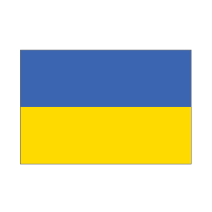
Ukrainian is the official language of Ukraine, spoken by approximately 40 million native speakers, with significant communities in Canada, the United States, Poland and the UK. The UK's Ukrainian-speaking population has grown substantially since 2022, making public-sector, healthcare and humanitarian translation the most consistent demand areas for UK organisations. The facts below cover script, speakers, grammar, register and the translation risks most relevant to professional content.
- Script: Cyrillic alphabet, 33 letters. Ukrainian Cyrillic differs from Russian Cyrillic in several characters, including ґ (he), є (ye) and і (i), which are not present in the Russian alphabet. Ukrainian and Russian scripts are not directly interchangeable.
- Speakers: Approximately 40 million native speakers globally, with the majority in Ukraine. Significant Ukrainian-speaking communities exist in Canada, the United States, Poland and the UK.
- Varieties: Regional dialects exist across northern, south-eastern and south-western Ukraine, with the south-western Galician dialect historically distinct. Standard Ukrainian is based on the central and eastern dialect and is used in formal, literary and official contexts.
- Grammar: Ukrainian is a highly inflected language with seven grammatical cases. Nouns, pronouns, adjectives and numerals all decline. Word order is relatively flexible but carries significant meaning through emphasis and register.
- Register: Ukrainian has formal and informal registers. The second-person singular has two forms: ty (informal) and vy (formal or plural). Choosing the wrong register in public-facing or professional communications signals a lack of cultural awareness.
- Distinction from Russian: Ukrainian and Russian are related but distinct languages. They share some vocabulary but differ significantly in phonology, grammar, spelling conventions and register. Ukrainian has also undergone deliberate de-Russification of its vocabulary, particularly since 2014. Translators must be qualified specifically in Ukrainian, not simply fluent in another Cyrillic-script language.
- Text expansion: Ukrainian text typically runs 15 to 25 percent longer than equivalent English, depending on content type. This is relevant for layout, DTP and any design work involving Ukrainian-language content.
When Ukrainian translation needs more than accuracy
Confusing Ukrainian with Russian damages trust
Ukrainian and Russian are different languages with different scripts, different grammars and different cultural associations. Delivering content described as Ukrainian but produced by a Russian-language translator, or using the Russian variant of a shared word, is an error that undermines trust before the message has any chance to land. In the current context, it is not a minor oversight. For organisations communicating with Ukrainian communities or operating in Ukraine, translator credentials must be verified before the project starts, not after delivery.
Soviet-era or Russian-influenced terminology undermines credibility in formal content
Ukrainian has been actively worked to distinguish its vocabulary from Russian-derived equivalents, particularly in government, education and public administration. Some older Ukrainian texts retain Russified forms. Modern formal Ukrainian, particularly in official communications and public-sector materials, uses the standardised Ukrainian equivalents. A translator relying on dated source material or unaware of current usage will produce copy that reads as outdated or out of step with current Ukrainian usage.
Cyrillic script errors signal that no one who knows the language checked the work
Ukrainian Cyrillic includes characters not present in Russian Cyrillic and excludes characters present in Russian. Substituting a Russian character for a Ukrainian one changes the letter entirely. These errors pass spell-check tools that are not set to Ukrainian but produce a text that no Ukrainian-fluent reviewer would let through. DTP and typesetting teams working on Ukrainian content must use Ukrainian-language fonts and proofreading tools, not Russian-language equivalents.
Gender-neutral or inclusive language requires specific translator expertise
Ukrainian is a grammatically gendered language. Every noun, adjective and verb form carries gender agreement. Producing gender-neutral or inclusive language in Ukrainian requires deliberate grammatical decisions that go beyond direct translation. For organisations producing content with inclusive language requirements, this must be agreed at brief stage and assigned to a translator with specific experience in this area.
це найкраще дзеркало його життя.»

AI suitability for Ukrainian translation
AI tools trained primarily on English and Russian-language data do not consistently distinguish Ukrainian from related Slavic languages, and they are prone to introducing Russified vocabulary or grammatical constructions. Output that reads smoothly is not output that is ready for a Ukrainian audience, and for this language the gap between the two carries additional weight.
In the current political context, an AI-generated text that reads as insufficiently Ukrainian is not a neutral error. It is a credibility problem. AI tools also do not reliably make informed decisions about register, formal and informal address, or the current state of Ukrainian vocabulary, which continues to evolve. Every Ukrainian project at Brightlines is reviewed by a translator qualified specifically in Ukrainian, with attention to register, current vocabulary standards and the precision that AI tools do not consistently maintain.
How clients use our Ukrainian translation services
Brightlines works with UK and international clients translating content into and from Ukrainian across a range of sectors, content types and registers.
- Humanitarian and NGO communications: programme documentation, beneficiary communications, donor reports and community-facing materials for organisations working with Ukrainian communities in the UK or operating in Ukraine. Specialist Led Translation is required because humanitarian content demands accuracy, cultural sensitivity and, in many cases, familiarity with the specific context in which displaced communities are receiving information. Register and tone must be confirmed before translation begins.
- Legal and compliance documents: contracts, immigration documentation, certified translations and regulatory materials for Ukrainian nationals in the UK or for organisations with legal obligations in Ukraine. Specialist Led Translation is required because Ukrainian legal terminology differs from Russian-influenced equivalents, and jurisdiction-specific knowledge is essential.
- Public sector and government communications: local authority information, NHS communications, benefits guidance and public health materials for Ukrainian-speaking communities in the UK. Specialist Led Translation is required because public-sector content must be accurate, unambiguous and appropriate for audiences who may be navigating unfamiliar systems under significant personal stress.
- Medical and health communications: patient information leaflets, public health campaigns, NHS communications and health guidance for Ukrainian-speaking communities in the UK. Specialist Led Translation is required because health content must use accessible Ukrainian at the appropriate register, with medical terminology handled accurately. The UK's Ukrainian-speaking population includes people navigating unfamiliar healthcare systems under significant personal pressure, and content that is unclear, tonally wrong or insufficiently Ukrainian in character fails them at the point when it matters most.
- Brand and marketing content: campaign copy, brand communications and marketing materials for organisations entering the Ukrainian market or communicating with Ukrainian audiences internationally. Creative Translation is essential here because tone, register and cultural resonance matter as much as linguistic accuracy. Marketing copy that reads as produced without knowledge of the audience fails to reach it.
- Corporate and internal communications: HR policies, employee handbooks, training materials and operational documentation for organisations with Ukrainian-speaking staff. Smart Translation delivers consistency and clarity at volume, with human review checking register, vocabulary standards and the Ukrainian/Russian distinction before delivery.
- Publishing and editorial content: books, reports, educational materials and editorial content translated into Ukrainian for publication or distribution. Creative Translation is essential for any content where voice, tone and readability matter to the finished work, with Specialist Led Translation for technical or reference content where accuracy and terminology are primary requirements.
What you get with Brightlines
Translators with sector experience in Ukrainian content
For you: translators matched to the content sector, not language pair alone.
Brightlines assigns every Ukrainian project to a translator with experience in the relevant content sector. A humanitarian translator brings familiarity with displaced-community communications and the register that public-facing humanitarian content demands. A legal translator brings knowledge of Ukrainian legal terminology and the jurisdictional conventions that contract and immigration work requires. A healthcare translator brings command of medical terminology and accessible Ukrainian for patient-facing content. Sector experience is what distinguishes a translator who can render the words correctly from one who can deliver content that does its job for the audience.
Full human review of register, vocabulary and Cyrillic accuracy
For you: register, current vocabulary standards and Cyrillic script accuracy confirmed before delivery, on every project.
All Ukrainian translation work at Brightlines goes through a human review stage that checks register, address form (ty versus vy), current vocabulary standards, Cyrillic character accuracy and the distinction from Russian-influenced forms against the project brief. The review applies to every project regardless of volume or deadline, and for content aimed at UK Ukrainian-speaking communities it confirms that vocabulary reflects current Ukrainian usage standards.
Awareness of context built into every project
For you: a translation partner that understands what is at stake when communicating with Ukrainian audiences.
Ukrainian communities in the UK and internationally are navigating significant pressures, and the content they receive from UK organisations matters to them. Brightlines brings that awareness to every Ukrainian project: translators are briefed on the audience context, the current state of Ukrainian vocabulary is considered against the source material, and cultural sensitivity is treated as a fixed requirement, not an optional refinement.
Get a quote for Ukrainian translation services in the UK
Brightlines is a UK translation agency providing Ukrainian translation services for NGOs, public-sector bodies, humanitarian organisations, publishers and businesses communicating with Ukrainian-speaking audiences in the UK and internationally. We work with qualified Ukrainian translators across legal, medical, marketing and operational content, with human review on every project before delivery. If you need Ukrainian translation handled with accuracy and cultural care, tell us about your project.


Sound local in every language.
If your content has to sell, persuade, reassure, or build trust, the choices between the words matter. We keep a human in control on every project, then use supportive tools only where they genuinely help. The result is writing that reads cleanly, stays consistent, and sounds like you, not a template.

Industry Experience

International Reach

Speed & Accuracy
Supported
Languages
We support a wide range of languages, from major global markets to specialist regional languages.