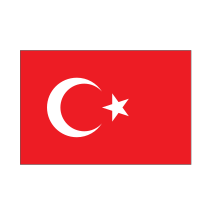
Turkish Translation Services
Orhan Pamuk, Turkey's Nobel Prize-winning novelist, built his fiction on the tension between register, voice and the weight a single word carries in Turkish. Agglutinative structure means each suffix changes the meaning of what came before. The wrong suffix does not produce awkward Turkish. It produces different Turkish.

Brightlines provides Turkish translation services for clients across the UK and internationally. As a UK translation agency, Brightlines works with brands entering the Turkish consumer market, technology companies localising for Turkish-speaking audiences, legal and immigration firms serving Turkish-speaking clients in the UK, travel and hospitality businesses, manufacturers with Turkish supply chain relationships, NGOs working in Turkey and healthcare and public sector bodies communicating with Turkish-speaking communities in the UK. Brightlines handles brand and marketing copy, legal and certified translation, software and digital localisation, technical and manufacturing documentation, travel and hospitality content and high-volume operational materials, matching every project to the correct register, politeness level and sector expertise.
Turkish at a glance
Turkish is spoken by approximately 80 million native speakers worldwide, primarily in Türkiye, with significant Turkish-speaking communities across Europe including Germany, the Netherlands, Belgium and the UK. The facts below cover script, structure, grammar, politeness and the translation risks most relevant to professional content.
- Script: Latin alphabet, introduced in 1928 as part of Atatürk's language reform. Turkish uses a phonetically consistent orthography, but meaning is carried largely in suffixes rather than separate words. This structural difference is where most translation errors begin.
- Agglutinative structure: Turkish builds meaning by stacking suffixes onto a root word. A single Turkish word can carry what English expresses in a full clause. Each suffix modifies the one before it. Errors in suffix selection change tense, possession, obligation, negation or politeness, often without making the sentence obviously wrong to a non-specialist reviewer.
- Word order: Turkish is a subject-object-verb language. The verb comes last. English sentence structures transferred directly into Turkish produce constructions that are grammatically possible but tonally foreign. Natural Turkish requires restructuring, not word-for-word conversion.
- Politeness system: Turkish encodes politeness directly into grammar through the choice between informal sen and formal siz. This is not a choice between casual and professional tone. It signals the relationship between writer and reader. In customer-facing and brand content, the wrong choice reads as either presumptuous or unnecessarily distant.
- Third-person pronoun: Turkish uses a single third-person pronoun, o, for he, she and it. Content that relies on gendered English pronouns requires the translator to restate the noun or role in Turkish for clarity. This must be resolved consistently across a document before translation begins.
- Text expansion: Turkish text typically runs longer than its English source, particularly in formal and legal register. UI layouts, formatted documents and packaging must account for this expansion.
- Translation risk: The most common Turkish translation failure is suffix error in short strings. A button label, error message or legal clause with an incorrect suffix can change whether something is permitted, required or prohibited, in a sentence where there is no surrounding context to recover the meaning.
When Turkish translation needs more than accuracy
A direct English request becomes a Turkish instruction without deliberate politeness handling
English encodes politeness largely through word choice and phrasing. Turkish encodes it through grammar. The choice of pronoun, the form of a verb and the structure of a request all signal the relationship between writer and reader in ways English does not. A word-for-word translation of a polite English request can produce a Turkish sentence that reads as a direct instruction. In a customer communication, that is not a tonal complaint. It is a credibility problem that surfaces in post-launch feedback rather than in translation review.
Suffix errors in short strings are invisible to generalist review and expensive to correct
In longer prose, a reader can recover meaning from context. In UI strings, error messages, button labels and legal clauses, there is no surrounding context. The suffix is the meaning. A single incorrect or missing suffix can change whether an action is permitted or prohibited, who bears responsibility, or when an obligation takes effect. This is the category of Turkish translation risk that is hardest to catch in a standard review and most costly to fix after publication, because it requires identifying affected strings across an entire product or document.
English noun compounds and passive constructions require restructuring, not translation
English stacks nouns freely and uses passive constructions naturally. Turkish does not. A noun compound that works in English product copy becomes incomprehensible when translated literally into Turkish. A passive sentence typically needs to be restructured entirely to read as natural Turkish. When this restructuring does not happen, the copy reads as slightly formal, distant and foreign, in a way that surfaces in client review rather than in a linguistic quality check.

AI suitability for Turkish translation
Turkish presents structural challenges for AI that do not announce themselves clearly in the output. The limitations emerge in content where politeness calibration, suffix precision and natural business phrasing are required. AI defaults to a register that Turkish speakers describe as sounding like an official notice: technically acceptable but tonally wrong for customer-facing or brand content.
More critically, the agglutinative structure of Turkish means that suffix errors can appear inside fluent-looking output. A sentence can be grammatically coherent and still contain a negation error, an obligation shift or a politeness miscalibration that only becomes visible to a qualified reviewer. Every Turkish project at Brightlines is checked by a translator with attention to suffix accuracy, politeness level and the tonal calibration the brief requires.
How clients use our Turkish translation services
Brightlines works with UK and international clients translating content into Turkish for brands entering the Turkish consumer market, technology companies localising for Turkish-speaking audiences, legal and immigration firms, travel and hospitality businesses, manufacturers with Turkish supply chain relationships, NGOs working in Turkey and public sector bodies communicating with Turkish-speaking communities in the UK.
- Brand and marketing copy: consumer and B2B marketing copy, campaign content and brand communications for Turkish-speaking audiences in Türkiye and across European Turkish-speaking communities. Creative Translation is essential here because Turkish consumer culture responds to direct, confident phrasing at the correct politeness level. The sen/siz decision and vocabulary preferences must be confirmed before translation begins and applied consistently throughout the campaign.
- Legal, certified and immigration translation: contracts, certified translations of identity documents, educational qualifications, criminal records and legal correspondence for Turkish-speaking individuals and organisations in the UK. Specialist Led Translation is required because Turkish legal register is distinct from standard written Turkish in vocabulary, obligation framing and suffix conventions, and certified translation for immigration and legal proceedings demands both accuracy and approvals-ready formatting.
- Technology and software localisation: UI strings, help documentation, onboarding flows, in-app copy and error messages for technology products entering the Turkish market. Specialist Led Translation is required because software localisation demands suffix-accurate terminology across all strings, and short UI strings are where Turkish suffix errors are most visible and most damaging. Turkey is a major and growing digital market with a sophisticated consumer audience.
- Travel and hospitality content: hotel communications, destination marketing, guest-facing copy, booking confirmation content and concierge materials for Turkish-speaking audiences. Creative Translation is essential here because Turkish hospitality audiences have clear expectations for warmth and register, and content that is technically correct but pitched at the wrong formality level reads as cold or institutional.
- Technical and manufacturing documentation: product specifications, operational procedures, equipment manuals, safety data sheets and supplier communications for UK businesses with manufacturing operations or supply chain relationships in Turkey, particularly in automotive, textiles and food production. Specialist Led Translation is required because technical Turkish carries precise terminology that varies by sector, and errors in safety or compliance documentation carry real operational risk.
- NGO and humanitarian programme materials: programme documentation, beneficiary communications, donor content and safeguarding materials for organisations working in Turkey or with Turkish-speaking refugee and diaspora communities. Specialist Led Translation for programme and compliance documentation, with Creative Translation for public-facing and fundraising content. Turkey hosts one of the world's largest refugee populations and is a primary operating region for UK international development and humanitarian organisations.
- Operational and internal content at volume: HR documentation, training materials, FAQs, policy updates and employee communications for organisations with Turkish-speaking workforces or operations. Smart Translation prioritises clarity and consistency at volume, with human review checking suffix accuracy, politeness register and terminology before delivery.
What you get with Brightlines
Turkish translators matched to sector
For you: translators matched to the content type, not just language pair.
Brightlines works with Turkish translators who hold professional experience in the relevant content sector. A translator for Turkish legal and certified translation brings knowledge of Turkish obligation language and the formal register requirements of certified documentation. A translator for brand or consumer marketing brings understanding of how Turkish-speaking audiences respond to different politeness levels and vocabulary choices. A translator for technical and manufacturing content brings familiarity with Turkish industrial terminology. At Brightlines, every Turkish project is matched to a translator with sector experience, not language competence alone.
Human-led review of Turkish suffix accuracy
For you: suffix accuracy, agreement and terminology confirmed before delivery.
All Turkish translation work at Brightlines goes through a human review stage that checks suffix accuracy, agreement across the suffix chain, vocabulary consistency and terminology against the project brief. The suffix check matters because Turkish builds meaning through stacked suffixes: case, possession, tense, person and modality can all attach to a single word, and an error early in the chain propagates through everything that follows.
Sen/siz register calibrated for the Turkish audience
For you: politeness level confirmed for Türkiye and diaspora audiences, not just grammatical correctness.
Brightlines translates brand and marketing content into Turkish with knowledge of how Turkish-speaking audiences across Türkiye and European diaspora communities respond to different registers and tonal choices. The sen versus siz decision is one of the most consequential register choices in Turkish, and it differs by sector, brand positioning and audience. Marketing and brand translation is reviewed for the right politeness level, the consistent application of sen or siz across the document and natural Turkish phrasing.
Get a quote for Turkish translation services in the UK
Brightlines is a UK translation agency providing Turkish translation services to brands, technology companies, legal and immigration firms, travel and hospitality businesses, manufacturers, NGOs and public sector bodies communicating with Turkish-speaking audiences in Türkiye, across Europe and in the UK. We work with brand and marketing copy, legal and certified translation, software and digital localisation, travel and hospitality content, technical and manufacturing documentation, NGO and humanitarian programme materials and high-volume operational content, matching every project to the correct Turkish register, politeness level and tier. If you need Turkish translation that reads as written for its audience, talk to us about your project.


Sound local in every language.
If your content has to sell, persuade, reassure, or build trust, the choices between the words matter. We keep a human in control on every project, then use supportive tools only where they genuinely help. The result is writing that reads cleanly, stays consistent, and sounds like you, not a template.

Industry Experience

International Reach

Speed & Accuracy
Supported
Languages
We support a wide range of languages, from major global markets to specialist regional languages.