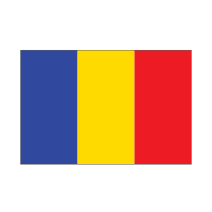
Romanian Translation Services
Mihai Eminescu, Romania's national poet, set the standard for modern Romanian with a precision the language still demands. Romanian is the only major Romance language to preserve Latin's case system: five cases, three genders and a definite article that attaches to the noun. Errors in any of these run through every sentence.

Brightlines provides Romanian translation services for clients across the UK and internationally. As a UK translation agency, Brightlines works with construction and facilities management businesses with Romanian-speaking workforces, brands and consumer businesses entering the Romanian market, legal and immigration firms, NGOs and development organisations, NHS trusts and healthcare bodies, pharmaceutical and life sciences organisations, and individuals and organisations requiring certified document translation. Brightlines handles workforce and safety documentation, brand and marketing copy, legal and certified translation, NGO programme materials, medical and pharmaceutical content, website localisation and high-volume operational materials, matching every project to the correct Romanian register, case conventions and diacritic standards.
Romanian at a glance
Romanian (română) is the official language of Romania and the Republic of Moldova, spoken by approximately 24 million native speakers. Romanian is an official language of the European Union, and the Romanian diaspora in the UK is one of the largest EU-origin communities in the country. The facts below cover script, grammar, register, the Romania/Moldova distinction and the translation risks most relevant to professional content.
- Script: Latin alphabet with five special characters: ă, â, î, ș (s with comma below) and ț (t with comma below). The comma-below diacritics on ș and ț are frequently confused with cedilla forms (ş and ţ) in digital contexts, creating a visible typographical error in published content. Correct Unicode encoding and font selection are essential for any Romanian translation project.
- Speakers: Approximately 24 million native speakers in Romania and Moldova, with significant diaspora communities across the EU (particularly Italy, Spain, Germany and the UK), the United States and Canada.
- Grammar: Romanian is a Romance language that uniquely preserved Latin’s case system. It has five grammatical cases (nominative, accusative, genitive, dative and vocative), three genders (masculine, feminine and neuter) and an enclitic definite article that attaches to the end of the noun. Adjectives must agree with nouns in gender, number and case. These features give Romanian a grammatical complexity closer to Latin than to its Romance siblings.
- Register: Romanian distinguishes between formal address (dumneavoastră, the polite form) and informal address (tu, the familiar singular). Business, legal and institutional communications use dumneavoastră as standard. Consumer and marketing content increasingly uses tu for a more accessible tone, following recent trends in Romanian commercial communication. The brief must specify which register is appropriate.
- Romania vs Moldova: Romanian as spoken and written in Moldova carries some vocabulary differences and a slightly different register from Standard Romanian as used in Romania. The written language is largely standardised, but consumer-facing content, marketing and community communications may need to reflect Moldovan conventions depending on the audience.
- Translation risk: The most common Romanian translation failure is producing text with incorrect case endings, gender agreement errors or misplaced articles. Romanian’s inflectional system means that grammatical errors ripple through the sentence because inflection connects every element, and a single case or gender error affects the whole construction.
When Romanian translation needs more than accuracy
The case system creates agreement requirements that English does not have
Romanian’s five-case system means that nouns, adjectives, articles and pronouns change form depending on their grammatical function. A genitive construction, a dative pronoun or a vocative address each require specific inflectional forms. Errors in case usage do not just sound wrong. They change the grammatical relationships within the sentence and can alter meaning. Translators working into Romanian must handle the case system with precision, which requires native-level grammatical competence, not just vocabulary knowledge.
The enclitic article is a distinctive feature that non-native translators often mishandle
Romanian is the only major Romance language where the definite article attaches to the end of the noun rather than preceding it. The word carte means book. The word cartea means the book. This is a fundamental structural feature of the language, and incorrect article placement or omission is a structural error that runs through the noun phrase. In compound noun phrases where adjectives are involved, the article placement rules become more complex. Translators must know these rules instinctively, not apply them as an afterthought.
The formal/informal distinction is shifting, and the brief must specify
Romanian is undergoing a register shift. Traditional business and institutional communication uses dumneavoastră (the polite form). But an increasing number of Romanian brands and companies, particularly in tech, e-commerce and consumer services, now address customers with tu, following a more informal, accessible tone influenced by English-language communication norms. Neither choice is wrong, but applying the wrong one for the context signals either stuffiness or overfamiliarity. The brief must specify the address convention, and the translator must know what is standard for the sector and audience.
Diacritic handling is a visible quality marker
Romanian’s five special characters (ă, â, î, ș, ț) must be rendered correctly. The most common error is using cedilla forms (ş, ţ) instead of the correct comma-below forms (ș, ț). This is a legacy encoding issue that persists in many digital systems, and it reads as a sign of carelessness or technical oversight in any professional Romanian context. Font selection, Unicode encoding (UTF-8) and PDF rendering must all be verified to ensure diacritics display correctly.
unui popor.”

AI suitability for Romanian translation
Romanian's inflectional system, with nouns, adjectives and articles all changing form across five cases and three genders, is where AI translation runs into consistent difficulty. Case agreement, gender matching and article placement are all areas where AI-generated output can appear plausible while being structurally wrong, and those errors compound across the sentence.
The enclitic definite article is handled inconsistently. Register calibration between formal and informal address is unreliable, with AI sometimes mixing the two within a single document. Diacritic handling also varies, with some AI systems producing cedilla forms instead of the correct comma-below characters, a legacy encoding error that persists in machine-generated Romanian. Every project is checked by a native Romanian translator before delivery, with particular attention to case agreement, enclitic article placement and the comma-below diacritics that AI systems handle inconsistently.
How clients use our Romanian translation services
Brightlines works with UK and international clients translating content into Romanian for construction and facilities management businesses with Romanian-speaking workforces, brands and consumer businesses entering the Romanian market, legal and immigration firms, NGOs and development organisations, healthcare and pharmaceutical bodies, and individuals and organisations requiring certified translation.
- Brand and marketing copy: consumer and B2B marketing copy for the Romanian market. Creative Translation is essential here because Romanian marketing copy must operate at the correct register for the audience, with the formal/informal distinction confirmed before translation begins. Romanian consumers respond to warmth and directness, but the tone must match the brand positioning.
- Legal and compliance documents: contracts, regulatory filings, EU compliance documentation and certified translations for Romanian organisations or international businesses operating in Romania. Specialist Led Translation is required because Romanian legal language carries specific case usage, formal register conventions and terminology that differ from standard written Romanian. Romania’s EU membership means legal translation must also account for EU regulatory frameworks.
- NGO and charity programme materials: programme documentation, community communications and impact reports for organisations working in Romania and with Romanian-speaking communities. Creative Translation for community-facing and fundraising content, with Specialist Led Translation for programme documentation and grant reporting where precision and cultural appropriateness are both requirements.
- Website and e-commerce localisation: marketing pages, product content, UI strings and digital interfaces for Romanian-speaking audiences. Creative Translation for brand and conversion-focused pages, with Smart Translation for support and informational content. Diacritic rendering (particularly the ș/ț comma-below forms) must be verified across all platforms.
- Medical and pharmaceutical content: patient information, clinical documentation and health communications for Romanian audiences. Specialist Led Translation is required because Romanian medical terminology draws on Latin roots but applies them in ways specific to Romanian medical practice, and register must be appropriate for patient-facing versus clinical content.
- Operational and internal content at volume: HR policies, training materials, onboarding documentation and internal communications for organisations with Romanian-speaking workforces in Romania, Moldova or the EU diaspora. Smart Translation prioritises clarity and consistency at volume, with human review checking case agreement, gender matching, register consistency and diacritic accuracy before delivery.
- Workforce and safety documentation: health and safety policies, toolbox talks, induction materials, HR documentation and compliance notices for UK construction, logistics and facilities management businesses with Romanian-speaking workforces. Smart Translation prioritises clarity and consistency at volume for standard HR and operational content, with Specialist Led Translation for safety-critical documentation where accuracy carries legal and operational risk. Romanian speakers form one of the largest non-English-speaking workforce groups in the UK construction sector, making this a distinctively Romanian demand area for UK employers.
- Certified and immigration translation: certified translations of identity documents, birth and marriage certificates, educational qualifications, driving licences and immigration documentation for Romanian-speaking individuals in the UK, and for UK organisations supporting Romanian-speaking staff with visa, settlement or documentation requirements. Specialist Led Translation is required because certified translation for UK legal and immigration purposes must meet specific accuracy and format standards, and Romanian document conventions differ from UK equivalents in ways that affect how they must be presented.
What you get with Brightlines
Romanian translators matched to register, sector and content type
For you: translators matched to the content type and register, with the grammatical precision Romanian demands.
Brightlines works with Romanian translators who are native speakers and hold professional experience in the relevant content sector. A legal translator brings knowledge of Romanian legal register, case usage and EU regulatory conventions. A brand translator brings understanding of how Romanian consumers respond to different registers and whether tu or dumneavoastră is appropriate for the audience. At Brightlines, every Romanian project is matched to a translator with the sector experience the content requires.
Human-led review of case, gender and register
For you: case agreement, gender matching, article placement and diacritic accuracy confirmed before delivery, not after feedback.
All Romanian translation work at Brightlines goes through a human review stage that checks case agreement, gender and number matching, enclitic article placement, register consistency and diacritic rendering against the project brief, with attention to the formal or informal register the brief specifies.
Romanian typesetting and diacritic rendering handled
For you: Romanian delivered ready to use, with the diacritics rendering correctly across digital and print.
Romanian uses ă, â, î, ș and ț, and historic content sometimes uses the legacy ş and ţ forms, which different fonts and systems handle inconsistently. Brightlines provides Romanian typesetting and checks that diacritics render correctly across digital and print, with text-length shifts against the English source accommodated in the layout. For voiceover and e-learning, scripts are prepared for the spoken register, which differs from the formal written conventions Romanian institutional content uses.
Get a quote for Romanian translation services in the UK
Brightlines is a UK translation agency providing Romanian translation services to construction and facilities management businesses, brands and consumer businesses, legal and immigration firms, NGOs and development organisations, NHS trusts and healthcare bodies, pharmaceutical and life sciences organisations, and individuals requiring certified translation. We work with workforce and safety documentation, brand and marketing copy, legal and certified translation, NGO programme materials, medical and pharmaceutical content, website localisation and high-volume operational materials, matching every project to the correct Romanian register, case conventions and diacritic standards. If you need Romanian translation that meets the grammatical precision and quality Romanian audiences expect, talk to us about your project.


Sound local in every language.
If your content has to sell, persuade, reassure, or build trust, the choices between the words matter. We keep a human in control on every project, then use supportive tools only where they genuinely help. The result is writing that reads cleanly, stays consistent, and sounds like you, not a template.

Industry Experience

International Reach

Speed & Accuracy
Supported
Languages
We support a wide range of languages, from major global markets to specialist regional languages.