Hungarian Translation Services
Sándor Petőfi, Hungary's national poet, wrote in a Hungarian whose directness transformed the literary language. That directness sits inside a structure unlike any Indo-European language. Hungarian is agglutinative: 18 grammatical cases, vowel harmony governing every suffix choice. A suffix error does not read as slightly wrong. It reads as broken.

Brightlines provides Hungarian translation services for clients across the UK and internationally. As a UK translation agency, Brightlines works with automotive and manufacturing businesses with Hungarian supply chain relationships, brands and consumer businesses entering the Hungarian market, legal and immigration firms, financial services organisations with Hungarian operations, NGOs and development organisations, NHS trusts and healthcare bodies, and individuals and organisations requiring certified document translation. Brightlines handles technical and manufacturing documentation, brand and marketing copy, legal and certified translation, financial services materials, NGO programme materials, medical and pharmaceutical content, website localisation and high-volume operational materials, matching every project to the correct Hungarian register, grammatical conventions and sector expertise.
Hungarian at a glance
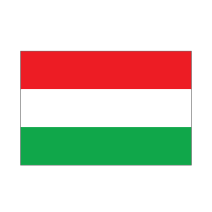
Hungarian (magyar) is the official language of Hungary, spoken by approximately 13 million native speakers, around 10 million of them in Hungary, with significant Hungarian-speaking minority communities in Romania, Slovakia, Serbia and Ukraine. Hungarian belongs to the Uralic language family, making it structurally unrelated to the Indo-European languages that surround it. The facts below cover language family, script, grammar, speakers, register and the translation risks most relevant to professional content.
- Language family: Hungarian belongs to the Uralic language family (Finno-Ugric branch), unrelated to the Indo-European languages that surround it. It shares distant structural similarities with Finnish and Estonian but is not mutually intelligible with either. This isolation means that translation into Hungarian cannot rely on cognates or structural parallels with other European languages.
- Script: Latin alphabet with 14 additional characters including accented vowels (á, é, í, ó, ö, ő, ú, ü, ű) and digraphs (cs, dz, dzs, gy, ly, ny, sz, ty, zs) that function as single letters. The Hungarian alphabet has 44 letters. Correct rendering of accented characters, particularly the distinction between short and long vowels (ö/ő, ü/ű), is essential because vowel length changes meaning.
- Grammar: Hungarian is agglutinative, building words by attaching suffixes to root forms. It has 18 grammatical cases, each expressed by a suffix attached to the noun. Vowel harmony governs which suffix variant attaches to which root: back-vowel words take back-vowel suffixes, front-vowel words take front-vowel suffixes. The verb system distinguishes between definite and indefinite conjugation depending on whether the object is specific or general. These features give Hungarian a grammatical density that has no equivalent in English.
- Speakers: Approximately 13 million native speakers, primarily in Hungary (around 10 million), with significant Hungarian-speaking minorities in Romania (Transylvania), Slovakia, Serbia (Vojvodina) and Ukraine (Transcarpathia). These minority communities maintain Hungarian as a working language, and content aimed at them may require regional considerations.
- Register: Hungarian distinguishes between formal address (Ön, the polite singular, and Önök, the polite plural) and informal address (te, the familiar singular). Business, legal and institutional communications use Ön as standard. Consumer and marketing content may use te for a more accessible tone depending on the brand and audience. The brief must specify which register is appropriate.
- Translation risk: The most common Hungarian translation failure is producing text that ignores the agglutinative system or applies suffix and conjugation patterns incorrectly. Hungarian's suffix system carries grammatical meaning that cannot be approximated, and errors in it surface as broken grammar rather than awkward phrasing. In Hungarian, suffixes carry grammatical meaning that cannot be approximated, so an error in one affects the words that depend on it.
When Hungarian translation needs more than accuracy
Agglutination means single words carry the weight of entire English phrases
Hungarian builds meaning through suffixes in a way that has no parallel in English. A single Hungarian word can express what English requires a preposition, a possessive pronoun and a noun to convey. This compression is not decorative. It is how the language works. Translation into Hungarian that breaks these constructions into separate words, following English syntax, produces text that is technically comprehensible but stylistically wrong. Translators must think in Hungarian structures, not translate English ones.
Vowel harmony is a structural rule, not a stylistic preference
Hungarian vowel harmony requires that suffixes match the vowel character of the root word. Back-vowel roots take back-vowel suffixes. Front-vowel roots take front-vowel suffixes. Errors in vowel harmony are the equivalent of conjugation errors in a Romance language: they mark the text as produced by someone without native command of the language. The regular cases are predictable, but loanwords, foreign names and mixed-vowel stems are where the rule is hardest to apply and where untrained translation goes wrong.
The definite/indefinite conjugation system encodes meaning that English leaves to context
Hungarian verbs conjugate differently depending on whether the object is definite (specific, known) or indefinite (general, unspecified). Látom means I see it (definite, specific object). Látok means I see (indefinite, no specific object). Using the wrong conjugation does not just sound awkward. It changes what the sentence means. In marketing, legal and technical content, this distinction affects precision, and errors undermine the credibility of the text.
Word order signals emphasis, not just grammar
Hungarian has a flexible word order, but that flexibility is not random. The element placed before the verb carries the emphasis. Changing word order in Hungarian changes what the sentence foregrounds, not just how it flows. In brand and marketing copy, this means that the translator must understand not just what the content says but what it emphasises. A direct transposition of English word order into Hungarian can produce a sentence that is grammatically correct but communicatively wrong, stressing the wrong element for the audience.
is érdemes tudni.”

AI suitability for Hungarian translation
Hungarian is a challenging language for AI systems. Its agglutinative structure, extensive case system, vowel harmony rules and definite/indefinite verb conjugation create a grammatical density that current AI models handle inconsistently. AI-generated Hungarian tends to produce suffix errors and incorrect conjugation choices, and it applies vowel harmony unreliably on loanwords and irregular stems. Word order, which carries emphasis in Hungarian, is handled unreliably, producing sentences that are grammatically passable but communicatively off-target. Register calibration between formal and informal address is inconsistent. For any content where grammatical precision, register and professional quality matter, AI output requires substantial human revision rather than light post-editing. Every Hungarian project at Brightlines is reviewed by a translator with native command of the language's morphology and the definite/indefinite conjugation distinction before delivery.
How clients use our Hungarian translation services
Brightlines works with UK and international clients translating content into Hungarian for automotive and manufacturing businesses with supply chain relationships in Hungary, brands entering the Hungarian market, legal and immigration firms, financial services organisations with Hungarian operations, NGOs working with Hungarian-speaking communities, healthcare bodies and individuals requiring certified translation.
- Brand and marketing copy: consumer and B2B marketing copy for the Hungarian market. Creative Translation is essential here because Hungarian marketing copy must operate at the correct register with word order calibrated for emphasis. Direct translation of English syntax into Hungarian produces text that sounds translated rather than written for the audience.
- Legal and compliance documents: contracts, regulatory filings, EU compliance documentation and certified translations for Hungarian organisations or international businesses operating in Hungary. Specialist Led Translation is required because Hungarian legal language carries specific formal register conventions, Latinate terminology and suffix patterns that differ from standard written Hungarian. Hungary’s EU membership means legal translation must also account for EU regulatory frameworks.
- Technical and manufacturing documentation: product specifications, quality standards, supplier communications, safety data sheets, equipment manuals and operational procedures for UK businesses with manufacturing operations or supply chain relationships in Hungary, particularly in automotive, electronics and precision engineering. Specialist Led Translation is required because Hungarian technical terminology combines international standards vocabulary with Hungarian suffixation patterns, and errors in safety or quality documentation carry real operational risk. Hungary's automotive sector, with major production facilities for Audi, Mercedes-Benz and Suzuki, makes this a distinctively Hungarian demand area for UK manufacturers and suppliers.
- Financial services and corporate communications: regulatory filings, fund documentation, investor communications and corporate governance materials for financial services organisations with Hungarian operations or Hungarian-speaking clients. Specialist Led Translation is required because Hungarian financial and corporate register carries formal suffix conventions and Latinate terminology that differ from standard written Hungarian, and EU regulatory frameworks add a further layer of compliance requirement.
- Website and e-commerce localisation: marketing pages, product content, UI strings and digital interfaces for Hungarian-speaking audiences. Creative Translation for brand and conversion-focused pages, with Smart Translation for support and informational content. Hungarian text expansion (typically 20–30% longer than English) must be accounted for in UI design and layout.
- Medical and pharmaceutical content: patient information, clinical documentation and regulatory submissions for the Hungarian market. Specialist Led Translation is required because Hungarian medical terminology combines Latin-derived roots with Hungarian suffixation patterns, and register must be appropriate for patient-facing versus clinical content.
- NGO and charity programme materials: programme documentation, community communications and impact reports for organisations working in Hungary and with Hungarian-speaking communities in neighbouring countries. Creative Translation for community-facing and fundraising content, with Specialist Led Translation for programme documentation and grant reporting. Hungarian-speaking minorities in Romania, Slovakia and Serbia may require regional vocabulary considerations.
- Operational and internal content at volume: HR policies, training materials, onboarding documentation and internal communications for organisations with Hungarian-speaking workforces. Smart Translation prioritises clarity and consistency at volume, with human review checking suffix accuracy, vowel harmony, conjugation correctness and register before delivery.
- Certified and immigration translation: certified translations of identity documents, birth and marriage certificates, educational qualifications, driving licences and immigration documentation for Hungarian-speaking individuals in the UK, and for UK organisations supporting Hungarian-speaking staff with visa, settlement or documentation requirements. Specialist Led Translation is required because certified translation for UK legal and immigration purposes must meet specific accuracy and format standards, and Hungarian document conventions differ from UK equivalents in ways that affect how they must be presented.
What you get with Brightlines
Hungarian translators with agglutinative command and sector knowledge
For you: translators matched to the content type and register, with the structural command of Hungarian that agglutinative grammar demands.
Brightlines works with Hungarian translators who are native speakers and hold professional experience in the relevant content sector. A legal translator brings knowledge of Hungarian legal register, Latinate terminology and EU regulatory conventions. A brand translator brings understanding of how Hungarian consumers respond to different registers and word order choices. At Brightlines, every Hungarian project is matched to a translator with native command of the agglutinative system and sector experience to match the content.
Human-led quality with suffix accuracy and vowel harmony checked
For you: suffix accuracy, vowel harmony, conjugation and register confirmed before delivery, not after feedback.
All Hungarian translation work at Brightlines goes through a human review stage that checks suffix correctness, vowel harmony, definite/indefinite conjugation, word order emphasis and register consistency against the project brief. The goal is Hungarian that reads as written by a native speaker for the intended audience, not corrected from a draft.
Copy restructured for Hungarian
For you: Hungarian copy that uses the language’s own structures naturally, rather than mapping English syntax onto Hungarian words.
Brightlines translates brand, legal and marketing content into Hungarian with knowledge of how Hungarian audiences process written communication. Hungarian’s agglutinative structure, flexible word order and suffix-driven grammar mean that content which reads naturally in English often needs to be restructured, not just translated, to work in Hungarian. Content produced for a UK brand entering the Hungarian market is reviewed for grammatical precision, natural Hungarian structure, cultural fit and correct register, not just linguistic accuracy.
Get a quote for Hungarian translation services in the UK
Brightlines is a UK translation agency providing Hungarian translation services to automotive and manufacturing businesses, brands and consumer businesses, legal and immigration firms, financial services organisations, NGOs and development organisations, NHS trusts and healthcare bodies, and individuals requiring certified translation. We work with technical and manufacturing documentation, brand and marketing copy, legal and certified translation, financial services materials, NGO programme materials, medical and pharmaceutical content, website localisation and high-volume operational materials, matching every project to the correct Hungarian register, grammatical conventions and sector expertise. If you need Hungarian translation that meets the structural precision and quality Hungarian audiences expect, talk to us about your project.


Sound local in every language.
If your content has to sell, persuade, reassure, or build trust, the choices between the words matter. We keep a human in control on every project, then use supportive tools only where they genuinely help. The result is writing that reads cleanly, stays consistent, and sounds like you, not a template.

Industry Experience

International Reach

Speed & Accuracy
Supported
Languages
We support a wide range of languages, from major global markets to specialist regional languages.