European French Translation Services
Gustave Flaubert spent days searching for 'le mot juste', the exact right word, and that standard has never left French writing. French readers judge content on expression as much as meaning. A translation that is correct but flat fails the brief. Accuracy is the floor. Style is the standard.

Brightlines provides European French translation services for clients across the UK and internationally. As a UK translation agency, Brightlines works with publishers and literary agencies, brands and luxury businesses, pharmaceutical and life sciences organisations, legal and immigration firms, aerospace and engineering companies, financial services organisations and travel and hospitality businesses translating into European French. France's Toubon Law requires the use of French in advertising, product labelling and workplace communications, making French translation a legal obligation for UK organisations operating in France, not just a commercial preference. Brightlines handles publishing and editorial translation, brand and marketing copy, pharmaceutical and regulatory documentation, legal and certified translation, technical and manufacturing content, financial services materials, travel and hospitality content, and high-volume operational materials, matching every project to the correct European French register, stylistic standard and sector expertise.
European French at a glance
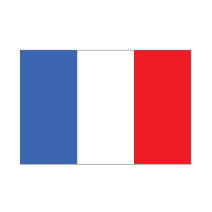
European French, also known as Metropolitan French, is the official language of France and the standard written variety used across French institutions, publishing and formal communication worldwide. Approximately 67 million native speakers in France, with European French also serving as the formal written reference for Belgian and Swiss French contexts and as the standard variety for much of Francophone Africa. The facts below cover script, grammar, register and the translation risks most relevant to professional content.
- Script: Latin alphabet with five diacritics: acute (é), grave (è), circumflex (ê), diaeresis (ë) and cedilla (ç). Omitting or misplacing diacritics is a visible error that signals carelessness to any French reader. French also uses specific quotation marks called guillemets (« ») rather than English inverted commas.
- Register: European French maintains strong formality conventions in business, institutional and public communication. The vous form is standard in professional and formal contexts. Marketing and consumer-facing content uses tu selectively and by sector. The tu/vous decision must be confirmed at the outset and applied consistently throughout.
- Stylistic expectations: French readers judge written content on quality of expression as a matter of course. A misplaced accent, an incorrect gender agreement, an awkward subjunctive construction or a sentence that follows English rather than French rhythm are all noticed and undermine credibility. Grammatical precision is a baseline. Stylistic quality is the standard.
- Anglicisms: Unlike Canadian French, which resists English loanwords, European French absorbs anglicisms selectively. Words like le marketing, le week-end and le shopping are standard in everyday and commercial French. The appropriate balance between anglicisms and native French vocabulary depends on the content type, sector and target audience, and requires judgment about how contemporary French operates in practice.
- Gender and agreement: French nouns carry grammatical gender, and adjectives, articles and past participles must agree in gender and number. Errors in gender agreement are visible throughout a text and mark content as produced without care.
- Regulatory context: France operates within EU regulatory frameworks and enforces the Loi Toubon (Toubon Law, 1994), which requires the use of French in advertising, product labelling, workplace communications and public-facing content in France. For UK organisations entering the French market, French translation is not optional. It is a legal requirement. French legal, financial and compliance translation also requires knowledge of French and EU jurisdiction and the specific register conventions that French legal language demands.
- Translation risk: The most common European French translation failure is producing text that is grammatically correct but stylistically flat. French readers expect written content to demonstrate craft. Translation that meets accuracy requirements but not stylistic expectations reads as translated.
When European French translation needs more than accuracy
Stylistic quality is a baseline expectation, not a premium requirement
French is a language where how something is written matters as much as what it says. A marketing headline that is grammatically correct but rhythmically awkward, a product description that follows English sentence logic, or a brand message at the wrong formality level all fail the same test. Translated content announces itself through texture rather than errors, and that perception diminishes the message before the argument has been made. Translators working into European French must write for a French reader, not convert from an English source.
The tu/vous decision is a brand choice, not a grammatical default
In European French, tu and vous signal the relationship between writer and reader, not just the level of formality. A luxury brand uses vous as part of its identity. A direct-to-consumer brand targeting younger French audiences may use tu to signal proximity. The choice must be confirmed before work begins and applied consistently across every piece of content in the project. A translator who defaults to one without instruction, or who varies between the two within a document, creates a register inconsistency that reads as careless to a French audience.
Anglicisms carry tonal weight and the balance matters by sector
European French absorbs English vocabulary in ways that Canadian French does not. In tech, startup and consumer marketing contexts, anglicisms read as contemporary and natural. In institutional, legal and formal publishing contexts, an excess of English borrowings signals laziness or insufficient command of the language. Getting the anglicism balance right requires a translator with current knowledge of how French is actually written in the relevant sector, not just grammatical competence.

AI suitability for European French translation
The limitation with AI output for European French is stylistic rather than structural, which makes it harder to catch and easier to approve without proper review. AI-generated European French tends to read as correct but flat: grammatically sound for informational content, but lacking the rhythmic quality and register precision that French readers expect from professional copy.
The tu/vous distinction, subjunctive usage and idiomatic naturalness all require human judgment that AI does not reliably provide. For publishing, marketing and brand content, AI output requires significant stylistic refinement by a human translator before it is ready for a French audience. Every European French project at Brightlines is reviewed by a translator who can refine the prose to the standard of expression a French audience expects, the stylistic work AI does not reliably do.
How clients use our European French translation services
Brightlines works with UK and international clients translating content into European French for publishers and literary agencies, brands and luxury businesses, pharmaceutical and life sciences organisations, legal and immigration firms, aerospace and engineering companies, financial services organisations and travel and hospitality businesses.
- Publishing and editorial translation: literary fiction, non-fiction, illustrated publishing and editorial content translated from French into English, and English-language works translated into European French for French publishers and international markets. Creative Translation is essential here because French publishing demands translators with editorial experience who can write French prose that meets French stylistic standards. France has one of the world's most significant literary translation markets, and both directions of translation require writers, not just linguists.
- Brand and marketing copy: consumer and B2B marketing copy, campaign content and brand communications for French audiences. Creative Translation is essential here because French audiences have high expectations for stylistic quality, and the tu/vous decision and register must be confirmed before translation begins. Copy that is grammatically correct but tonally flat or rhythmically awkward reads as translated to a French audience.
- Pharmaceutical and regulatory documentation: clinical trial materials, regulatory submissions, summary of product characteristics, patient information leaflets and pharmacovigilance content for pharmaceutical and life sciences organisations with French regulatory relationships. Specialist Led Translation is required because French pharmaceutical and regulatory terminology follows specific ANSM (Agence nationale de sécurité du médicament) and EMA conventions, and errors in clinical or regulatory documentation carry real compliance risk.
- Legal, certified and immigration translation: contracts, certified translations of identity documents, educational qualifications, criminal records, corporate governance documents and legal correspondence for French-speaking individuals and organisations in the UK, and Toubon Law compliance documentation for UK organisations operating in France. Specialist Led Translation is required because French legal register carries specific formality conventions and terminological precision requirements that differ from standard written French, and certified translation demands accuracy and approvals-ready formatting.
- Travel, hospitality and luxury brand content: hotel communications, destination marketing, luxury brand copy, concierge materials and travel content for French audiences. Creative Translation is essential here because French readers in the travel and hospitality sector treat quality of written expression as a baseline expectation, and a poorly written communication from a luxury brand damages the brand before the message is read.
- Website localisation: marketing pages, product content and compliance text for French audiences. Creative Translation for brand and conversion-focused pages, with Specialist Led Translation for terms, conditions and regulatory content. Both tiers must be aligned to European French conventions and the tu/vous decision confirmed before work begins.
- Operational and internal content at volume: HR documentation, training materials, FAQs and policy updates for organisations with French-speaking workforces or operations. Smart Translation prioritises clarity and consistency at volume, with human review checking European French register, grammatical agreement and vocabulary before delivery.
What you get with Brightlines
Translators who write European French
For you: translators who write French, not just translate into it.
Brightlines works with European French translators who are native to France and hold professional experience in the relevant content sector. A translator for pharmaceutical and regulatory documentation brings knowledge of ANSM and EMA submission conventions and the formal register requirements of French regulatory content. A translator for publishing and literary work brings editorial experience and the stylistic skill to produce French prose that meets French readers' expectations. At Brightlines, every European French project is matched to a translator with sector experience and the stylistic range the content requires.
Human-led quality with tu/vous consistency and stylistic precision
For you: register, address form and stylistic quality confirmed before delivery.
Every European French translation project at Brightlines is reviewed by a human specialist before delivery, with checks for tu/vous consistency, gender agreement, diacritic accuracy, register and stylistic flow against the project brief. The result is French that meets the precision and polish expected by professional and consumer audiences.
European French stylistic standards
For you: European French copy that reads as written for a French audience.
Brightlines translates brand and marketing content into European French with knowledge of how French audiences judge written content and respond to different registers and tonal choices. Copy that is correct but flat, or that applies anglicisms at the wrong density for the sector, does not serve a brand entering the French market. Brightlines reviews marketing and brand translation for stylistic quality, register fit and natural French expression, not just grammatical accuracy.
Get a quote for European French translation services in the UK
Brightlines is a UK translation agency providing European French translation services to publishers and literary agencies, brands and luxury businesses, pharmaceutical and life sciences organisations, legal and immigration firms, aerospace and engineering companies, financial services organisations and travel and hospitality businesses with French-speaking audiences. We work with publishing and editorial translation, brand and marketing copy, pharmaceutical and regulatory documentation, legal and certified translation, travel and hospitality content, website localisation and high-volume operational materials, matching every project to the correct European French register, stylistic standard and tier. If you need European French translation that meets the standards French audiences expect for written quality, talk to us about your project.


Sound local in every language.
If your content has to sell, persuade, reassure, or build trust, the choices between the words matter. We keep a human in control on every project, then use supportive tools only where they genuinely help. The result is writing that reads cleanly, stays consistent, and sounds like you, not a template.

Industry Experience

International Reach

Speed & Accuracy
Supported
Languages
We support a wide range of languages, from major global markets to specialist regional languages.