Afrikaans Translation Services
Ingrid Jonker, one of South Africa's most celebrated poets, stripped away ornamentation and said exactly what she meant. Afrikaans rewards that. More concise than English and simpler than Dutch, it looks like the easier translation target. It is not. Concision and simplicity are hardest to achieve when the source copy was not written that way.

Brightlines provides Afrikaans translation services for clients across the UK and internationally. As a UK translation agency, Brightlines works with brands and consumer businesses entering South African and Namibian markets, NGOs and development organisations working with Afrikaans-speaking communities, legal and compliance teams, publishers with South African distribution, healthcare organisations, mining and resources companies with South African or Namibian operations, financial services businesses with South African investment or operational exposure and organisations with Afrikaans-speaking workforces. Brightlines handles brand and marketing copy, legal and compliance documentation, NGO programme materials, medical communications, publishing and editorial content and high-volume operational content, matching every project to the correct Afrikaans register, regional variety and cultural context.
Afrikaans at a glance
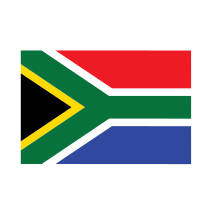
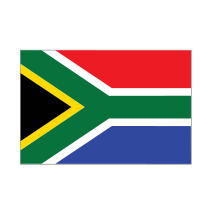
Afrikaans is a West Germanic language spoken primarily in South Africa and Namibia, with approximately 6.6 million native speakers and is also widely used as a second or third language. It is the third most widely spoken home language in South Africa and an official language of both South Africa and Namibia. The facts below cover script, grammar, regional varieties, register and the translation risks most relevant to professional content.
- Script: Latin alphabet. No special script requirements, but diacritics appear in some loanwords and proper nouns. Phonetic spelling is a core feature: words are spelled as they are pronounced, which simplifies written production but creates pitfalls for translators who rely on Dutch cognates.
- Speakers: Approximately 6.6 million native speakers, with a further 10 million using it as a second or third language. Afrikaans is the third most widely spoken home language in South Africa, after Zulu and Xhosa.
- Origin: Descended from 17th-century Dutch spoken by settlers at the Cape of Good Hope, modified over two centuries by contact with Malay, Khoisan languages, Portuguese, Bantu languages and South African English. It was officially recognised as a separate language from Dutch in 1925.
- Grammar: Significantly simplified compared to Dutch. No grammatical gender, no case inflections on nouns, and minimal verb conjugation. Afrikaans uses a double negative construction (ontkennende vorm) that does not exist in Dutch or German: Hy kan nie Afrikaans praat nie, meaning "He cannot speak Afrikaans".
- Relationship to Dutch: 90 to 95 percent of Afrikaans vocabulary is of Dutch origin, but the two languages are not mutually intelligible in speech. Dutch speakers find Afrikaans easier to follow than Afrikaans speakers find Dutch. Translating Dutch copy as a proxy for Afrikaans is a serious error and will produce text that reads as foreign.
- Regional varieties: Regional dialects include Kaapse Afrikaans (Cape Afrikaans) and Oranje Rivier-Afrikaans (Orange River Afrikaans), each with distinct vocabulary and pronunciation. Urban Afrikaans, particularly in Cape Town, carries significant English influence. Translator matching to the correct regional variant matters for consumer and community-facing content.
- Register: Afrikaans tends toward directness and informality even in professional contexts. Formal register exists but is rarely used in modern communications. Content that adopts an inappropriately formal tone can feel stiff and institutional to Afrikaans readers.
- Political and cultural context: Afrikaans carries a complex social history as the language associated with apartheid in South Africa. For NGO, public sector or community communications, cultural sensitivity around language framing is a commissioning consideration, not just a linguistic one.
groot helder Weste en die magiese Afrika.”

When Afrikaans translation needs more than accuracy
Dutch is not a reliable proxy for Afrikaans
The vocabulary overlap between Dutch and Afrikaans is high enough that a Dutch translator might appear adequate. It is not. Pronunciation, idiom, grammar structure and cultural register have all diverged substantially. Content written from a Dutch rather than an Afrikaans perspective is apparent in idiom, register and cultural reference throughout. For commercial, consumer or community content, that mismatch undermines the credibility of the message.
Simplified grammar does not mean simpler translation
Afrikaans grammar is less complex than Dutch, but that does not make Afrikaans translation easier. The challenge shifts from grammatical accuracy to tonal accuracy. English source text with layered register or implied meaning requires active choices about how to render it in a language where directness is the default. A translator who reaches for a literal rendering will produce Afrikaans that sounds translated rather than written.
The double negative is a structural feature, not an error
Afrikaans uses a double negative as standard grammatical structure. Ek wil dit nie doen nie means "I do not want to do this." This construction appears in all registers, including formal and legal text. English speakers reviewing Afrikaans translations may flag double negatives as mistakes. Reviewers without Afrikaans linguistic knowledge should not be approving Afrikaans copy on grammatical grounds.
Informality carries meaning that formal English does not expect
Afrikaans uses a relatively flat register across most communication contexts. What reads as informal in English often reads as perfectly standard in Afrikaans. Brand copy that has been calibrated in English to feel warm but professional may need to be recalibrated for Afrikaans, where the same warmth is achieved differently and excessive register-marking can feel condescending or bureaucratic.
Cape Afrikaans and standard Afrikaans are not the same audience
Urban Afrikaans, particularly in Cape Town and the Western Cape, contains significant English loanwords and code-switching that standard Afrikaans does not. Consumer and community-facing content for a Cape Town audience and content for a rural Free State audience are not the same brief. The target community and geography should be specified at the start of the project, not left as an assumption.
AI suitability for Afrikaans translation
Afrikaans AI output can look convincing to a reviewer who does not read the language natively, and that surface plausibility is the real risk. AI tools that lean on Dutch and English training data do not reliably handle Afrikaans register, idiomatic expression or the tonal directness that makes Afrikaans communication effective. The double negative construction is sometimes incorrectly modified. Regional vocabulary differences between Cape Afrikaans and standard Afrikaans are not reliably distinguished.
The cultural and political sensitivity around Afrikaans framing, which is relevant in NGO, public sector and community contexts, is not something AI can navigate. Because Afrikaans is a lower-resource language than Dutch, Spanish or French, AI confidence should be treated with more caution, not less. Every Afrikaans project at Brightlines is reviewed by a translator with native command of Afrikaans register and regional variety, with particular attention to the idiomatic and tonal calibration that AI trained on Dutch and English cannot reliably provide.
How clients use our Afrikaans translation services
Brightlines works with UK and international clients translating content into and from Afrikaans across a range of sectors and content types. Projects include organisations entering South African and Namibian markets, NGOs working with Afrikaans-speaking communities, publishers with South African distribution, and businesses with Afrikaans-speaking workforces.
- Brand and marketing copy: campaign content, advertising copy and brand communications for South African and Namibian markets. Creative Translation is essential here because Afrikaans consumer audiences respond to directness and cultural familiarity. Register, tone and vocabulary must be set at brief stage and confirmed against the specific target community, whether Western Cape urban, regional or nationally distributed.
- Legal and compliance documents: contracts, regulatory submissions and certified translations for commercial, employment and immigration purposes. Specialist Led Translation is required because Afrikaans legal terminology follows South African law, which is a hybrid of Roman-Dutch and English common law. Translation without jurisdictional knowledge creates compliance risk.
- Mining, resources and energy documentation: safety procedures, environmental compliance reports, operational communications, HR policies and regulatory submissions for UK and international mining and resources companies with South African or Namibian operations. Specialist Led Translation is required because mining and resources documentation carries technical and safety terminology that does not transfer cleanly, and errors in safety or compliance documentation carry real operational and legal risk. South Africa's mining sector is one of the largest in the world, and Namibia's uranium and diamond industries generate consistent demand for specialist Afrikaans translation from UK and international operators.
- Financial services and investment documentation: regulatory submissions, investor communications, fund documentation, compliance materials and financial reporting for UK financial services businesses with South African or Namibian operations or investment exposure. Specialist Led Translation is required because South African financial regulation is governed by the Financial Sector Conduct Authority (FSCA) and the Prudential Authority, each with precise terminology conventions that differ materially from UK and European equivalents. South Africa's financial sector is one of the most developed on the African continent, with deep connections to UK investment, asset management and banking.
- NGO and development programme materials: community outreach, programme documentation and donor communications for organisations working with Afrikaans-speaking populations in South Africa and Namibia. Creative Translation for public-facing and community content, with Specialist Led Translation for programme documentation where accuracy and cultural appropriateness are both requirements. Cultural sensitivity around Afrikaans framing in community contexts is discussed before work begins.
- Medical and health communications: patient information, clinical documentation and public health content for Afrikaans-speaking communities. Specialist Led Translation is required because medical content demands translators with verified terminology knowledge for the South African context. Afrikaans-speaking communities span both urban and rural populations with different health communication needs.
- Publishing and editorial content: books, educational materials and digital content for South African and international distribution. Creative Translation for narrative and consumer content, with Specialist Led Translation for educational and reference materials. Afrikaans publishing has a distinct literary tradition and editorial voice; translators with publishing experience in the language deliver a measurably different result.
- Operational and internal content at volume: HR policies, training materials, FAQs and product documentation for organisations with Afrikaans-speaking staff or operations. Smart Translation prioritises clarity and consistency at volume, with human review checking register, idiomatic accuracy and double negative construction before delivery.
What you get with Brightlines
South African and Namibian market knowledge
For you: copy that reaches Afrikaans readers as intended, not as translated.
Brightlines works with Afrikaans translators who hold professional experience in the relevant sector and regional market. A translator for Western Cape consumer content brings different knowledge from one working on Namibian government communications or South African legal documentation. At Brightlines, every Afrikaans project is matched to a translator with the right regional knowledge, sector experience and understanding of the cultural context the content requires.
Human-led quality with Afrikaans register and idiomatic accuracy confirmed
For you: regional register and cultural tone confirmed before delivery, not after complaints.
All Afrikaans translation work at Brightlines goes through a human review stage that checks register, idiomatic accuracy, correct double negative construction and tonal appropriateness against the project brief. The review also confirms that the tonal calibration distinguishes the copy from Dutch and English defaults, which AI and non-native translators consistently miss.
Political and cultural context built in
For you: Afrikaans copy that accounts for what the language carries, not just what it says.
Afrikaans is not a neutral language in Southern African contexts. Brightlines brings awareness of the cultural and political dimensions of Afrikaans communication to every brief, and raises relevant considerations with clients before work begins. This matters most for NGO, public sector and community-facing content, where framing decisions have consequences beyond translation accuracy.
Get a quote for Afrikaans translation services in the UK
Brightlines is a UK translation agency providing Afrikaans translation services for brands, NGOs, publishers, mining and resources companies, financial services businesses, healthcare organisations and organisations working with South African and Namibian markets or Afrikaans-speaking communities. We work with marketing and brand copy, legal and compliance documentation, medical communications, NGO programme materials, publishing and editorial content, and high-volume operational content. Every project is matched to a translator with the right regional knowledge and sector experience. If you need Afrikaans translation that accounts for register, cultural context and the specific audience you are reaching, talk to us about your project.


Sound local in every language.
If your content has to sell, persuade, reassure, or build trust, the choices between the words matter. We keep a human in control on every project, then use supportive tools only where they genuinely help. The result is writing that reads cleanly, stays consistent, and sounds like you, not a template.

Industry Experience

International Reach

Speed & Accuracy
Supported
Languages
We support a wide range of languages, from major global markets to specialist regional languages.